





Front Page
Mannequin settles Nest
By Richard Ritterbusch   
The university reached an agreement on Tuesday with the band Jack’s Mannequin that settled a legal dispute over the band’s failure to perform for the Nest Fest concert on campus March 30.

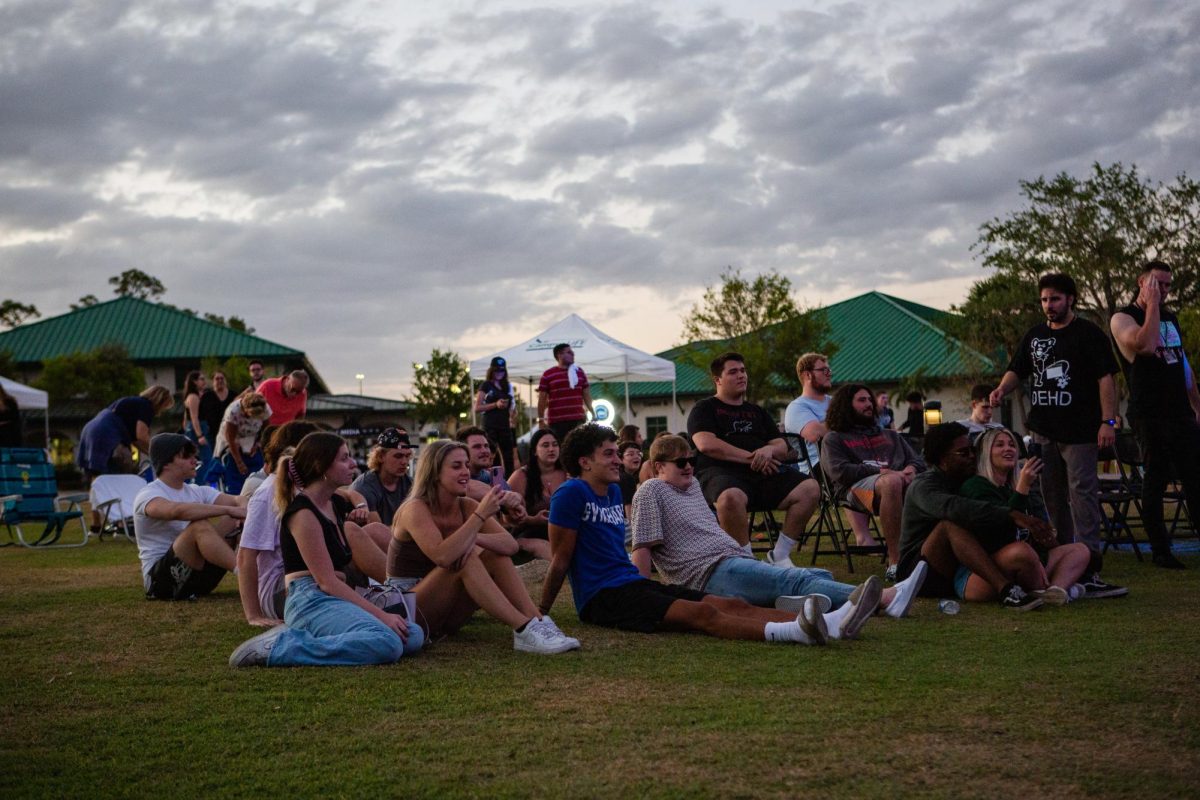
Image
Students waiting for Nest Fest
Part of the settlement included
the band retaining half the original
contracted amount, or $13,750, of
the $27,500 they would have received
if they had successfully completed
the show, according to the executed contract signed by the band’s manager, Aaron Dixon, and FGCU V.P. Dr. Joseph Shepard.

Another stipulation put forth by the band was that they were allowed to have a letter of explanation published in Eagle News in order to air their side of the story to students and fans.

Responding to a request by FGCU Asst. General Council Vee Leonard, EN management agreed to print the letter, which appears elsewhere in this issue.

The band’s front man, Andrew McMahon, maintains that he made the decision -- in conjunction with three separate sound reinforcement crews on the scene -- to withdraw for safety reasons, as well as a consensus opinion among sound technicians that the system was damaged beyond useful repair. McMahon also claimed in the letter that the local sound company, contracted by FGCU to provide the equipment for the concert, used a system that was different from the one specified in their advance agreement. He suggested that if the equipment switch was not with the consent of the FGCU promoters, he hoped the “school is fully reimbursed by the sound company.” The university could not be reached late Wednesday for comment on whether the other bands or the sound company would be also returning money to the university.
Triumphs of a Blind Student
By Sarah Watts   
Have you wondered how blind or disabled people are able to do well in their classes? Have you been curious how they read or take exams?

The answer: the Adaptive Services office.

I am a totally blind student who lives on campus and takes full advantage of the Adaptive Services office, though I did so more last semester than I do now. They’ve helped me throughout my academic career by providing me with a place to take my exams, books on tape and other class-related services.

However, that is the extent to which they assist me. There is another agency, the Division of Blind Services that provides me with the appropriate funding I need for my academic pursuits, and more often than not, the Adaptive Services office and DBS work together to provide a road as smooth as possible for me.

My daily routine differs greatly from most others. My typical Tuesday, for instance, begins at about 7 a.m., most times, anyway.

I roll out of bed and hit the “on” button for the computer. While it’s booting up, I prepare my morning coffee. I can tell how full the mug is just by the pitch changes in the water, and to check, I’ll briefly place my finger in the top of the mug. If I can place my finger about half way in, then I know it’s enough but not too much.

While it’s brewing, I’ll pull up Outlook, and with the help of a screen reader called JAWS for Windows, I’ll read my e-mails. I also do a little bit of net surfing via the same program.

JAWS for Windows is a text to speech program that turns everything on the screen into synthesized speech. This is how I do all of my homework, as well. So, I usually don’t go to the Adaptive Services office for that.

At about 11:30 a.m., my orientation and mobility instructor comes to work with me on routes. Our current route is the walk from the dorms to campus.

Unlike other students, I literally have to memorize how to get to places because I can’t read building signs from a distance, and I don’t have the same visual aids, like stop signs, the location of certain trees, etc. I also have to use clues such as trashcans or cars, and landmarks like a building itself or something else permanent, to get me places on campus.

Clues are things that can be moved; landmarks are things that cannot be moved. I use a white cane to navigate my environment and to keep me from running into the very landmarks I am trying to use. After my mobility lesson, I will sometimes eat on campus, and sometimes not, depending on how I feel that particular day. Either way, I eventually wind up back at my dorm doing more homework before I leave at 1:30 p.m. for my 2 p.m. class.

Like many of the students here, I utilize the shuttles to get me to and from campus, because I’m not yet comfortable with walking there. Unlike other students, however, I do not have the option of driving. The campus shuttles are, most often, the only way I can get anywhere on campus, though I do have a few friends who are willing to take me places on and off campus. On my way back from class is when I stop at the Adaptive Services office.

The Adaptive Services office, directed by Cori Bright, has been one of the most important places on campus for me. This office has helped me in past semesters with my exams by verbally reading them to me and writing out my answers, or by allowing me to write answers and essays using a computer that is also equipped with JAWS for Windows.

It is a federal law that anyone with a disability is to be given twice the normal amount of time to complete an exam. When the time comes, the professor will drop off the exam at Cori’s office and I come in and take it. It’s my responsibility to set up an appointment with her or a member of her staff.

There are also volunteers who read books for me onto cassettes because I can’t read print, and while Braille books while well, they take up a lot of space. Contrary to popular belief, most Braille books are not smaller than print books, unless they are books for very young children.

There have been some difficulties with readers getting materials in the office in a timely fashion, especially at the beginning of this semester. When this happens, it frustrates both Cori and me. I don’t have my materials on time, and it reflects poorly on Cori when the readers don’t do their jobs.

This semester, however, I don’t have any exams, only final projects, so I don’t need the office for that service any more. I do still need it for my books, and sometimes for other little things that need to be read. They have also assisted me in finding places on campus that I’ve never been to before or places that are hard to get to because of construction or other difficulties. For the most part, though, I navigate campus independently.

Since I use my computer to do a lot of my assignments and because I can’t see (and have had a few printer mishaps because of it), many of my professors allow me to e-mail my assignments to them, and request that I do it on the same day as the rest of the class. This is so that I don’t have an unfair advantage over the rest of the students.

If I do need an extension, I will go up and speak directly to the professor, something I had to do this semester due to the difficulty I mentioned earlier. Most professors are very understanding, and, within reason, give me the time I need to finish the assignment. Due to problems like this, I must communicate more closely with my professors than many students may.

After stopping off at the Adaptive Services office to check for tapes, I ride the shuttle home, and usually stay in the rest of the day. I usually arrive home around 5:15 p.m.

When I’m home, I’ll use the microwave, which had been marked for me, to cook up a frozen dinner to eat. Then, it’s back on the computer for instant messaging and more homework, while I listen to music in the background (low so that I can also hear the computer.)

As for those who work in Adaptive Services, their jobs aren’t easy. They are the ones who make up accommodation sheets, which are lists of a student’s disability and the accommodation they might need. It’s the disabled student’s responsibility to give them to professors at the beginning of every semester.

They are also the ones who process all incoming disabled students, and make sure they know what their responsibilities are. They field the complaints of said students when they become frustrated because something isn’t going the way it should, and they sometimes help deal with uncooperative professors and professors who grow irritated with students who don’t do things on time.

There are approximately 300 disabled students registered with Cori’s office, and there might even be more who aren’t. It is because there are so many that much of the responsibility now rests on the students themselves.

I, for example, am responsible for finding out what books a certain library doesn’t have, and must then e-mail the list of books to DBS and to Cori. Then Cori has to wait on a purchase order from DBS so either she, or someone from her office, can buy the books to be given to the readers.

Most of these activities actually take place before the semester begins, so that when I come to FGCU, I already have most of my books already read. For the most part, this has worked out well, but it’s not always flawless. The road I travel is not an easy one, but I wouldn’t be the person I am today without all the trials and bumps along the way.

I always try to keep a smile and a laugh for anyone who needs it, even if the laugh is on me. I often make gentle jokes about being blind, and I can’t count the number of times others have made the same gentle jokes on me. I like it that way. I’ve never seen, and perhaps never will.

My advice: close your eyes for ten minutes. Sit, listen. Then open your eyes and write down what you’ve heard or what you think about it. I bet you will pick up so much more without the distraction of your eyes. Use that awareness then. Use it to grow and prosper. I promise you, you won’t regret it.
New Housing Policy Wait-Lists Current Students
By Andrew Townsend   
More than 350 students living in housing at North Lake Village received e-mails March 22 informing them that they were wait-listed for campus housing in the 2007-08 year. The Office of Housing and Residence Life has assigned approximately 800 spaces at NLV for returning students next year, and reserved 1,100 spaces for incoming freshman. More than 1,100 current residents signed up to return. The result of the overwhelming amount of students requesting to return to the dorms was a wait-list of more than 350 residents. Students returning to NLV, which can house 1,945 students, have traditionally been given priority in housing. For the first time at FGCU, a limit has been placed on how many students can return next year because of a shortage of rooms. Previous years have shown that about 50 percent of NLV residents return the following year. This year, 64 percent signed up to return. The problem with this unexpected increase in students wanting to remain in housing is that it doesn’t leave enough room for incoming freshman. New dorms will not be up until fall 2009, with the opening of South Village and 400 new beds. So ultimately, it is up to the Office of Housing and Residence Life to determine who gets housing and who doesn’t. “We may not be able to allow all upper-classmen to stay,” said Dr. Pam Schreiber, director of the Office of Housing and Residence Life. In the two weeks following housing assignments and the wait-list, 200 students canceled their contracts for next year. The current wait-list of returning students stands at only 176. One of the most interesting aspects about this problem is that at other universities, it is not an issue. Most students don’t live on campus for more than one or two years at other schools. This is a new policy for FGCU, and while it surprised many students, it is consistent with the larger universities, like the one that FGCU is growing into. While a wait-list is a sign of FGCU’s growth, it is also a growing pain and an inconvenience to the affected students. Some feel forced off campus to live in Coastal Village, College Club or the surrounding, local residences. Some may even leave FGCU completely. Others worry that they may not have cars and can’t commute. The wait-list prompted students to organize and make their grievances heard. The affected returning students spoke at the Student Government Senate and the Resident Housing Association meeting. At the Senate meeting, a resolution was passed in support of their grievances. One of the main complaints was that the students didn’t feel involved in the planning process of this policy. “Students were not involved in planning the allocation (or) deciding if there’s going to be a limit of returnees and how that will be enforced,” said Dr. Schreiber. “I’ve talked to the Senate and RHA representatives. I am looking forward to having an advisory committee to assist us in determining that if we have to continue to put a limit on returning student spaces, they can help us with that decision.” Newly-elected student Senator, Sean Terwilliger, presented the group’s resolution in the March 27 Senate meeting. “This sets a precedent for poor planning in the future,” said Terwilliger, “which is especially dangerous considering FGCU’s rapid growth.” The root of this problem and the subsequent student reaction is most likely due to FGCU’s rapid growth, which is approximately 14 percent a year. “The university is just growing so fast, so fast,” said Vice-President of Student Affairs, Dr. Mike Rollo. “The fastest in the state, maybe in the country.” The construction of FGCU’s infrastructure lags behind the growth of its student population. South Village is scheduled to open in fall 2009 with 400 beds in a five-story building. FGCU plans for about 2,600 more spaces. This will provide space on campus for about 5,000 students, an expected 20 percent of the student population of 25,000 in 12-15 years. However, South Village faces many challenges in its construction. First, a land bridge must be constructed through the wetlands because of environmental restrictions. Also, a new physical plant has to be built along with dining and other residential accommodations. “We have some of the most beautiful residence halls in the country,” said Dr. Rollo. “I’ll match those with anybody’s as far as they look and feel, and the lifestyle. The students love them and that’s why we have this problem.”
FGCU Hosts Gen. Colin Powell
By Tony Mercurio   

Former Secretary of State Colin Powell visited Southwest Florida last Friday evening when he spoke at Alico Arena to students, professors and local residents about diplomacy and world affairs. Powell led his speech with compliments. “I have never seen a university that has done as much as this university has in ten short years,” he said, in addition to complementing the women’s basketball team on its successful season. Over the next hour, Powell lectured on internationalism, leadership and the future of the United States. He talked about his dealings with China, Russia, Korea, Japan, Africa and many

Image
Colin Powell using hand gestures to accentuate his words. (Photo by Carlos Calante)
other places. Powell was intent
on stressing the importance of
America’s image in the
international community. To
illustrate the significance on
a level closer to home, he told the story of a group of Brazilian exchange students. These students were eating in a Chicago restaurant one evening when they realized that they couldn’t pay their bill. The owner came out and told them not to worry, that their meal was a gift and he was glad to have them in America. The foreign students would then, presumably, go back to their homeland and tell the very same story, creating a positive image for America abroad. Powell alleged that this was the real America, with kind and understanding people who are the backbone of the country, and are “the greatest strength we have.” Despite his optimism, Powell acknowledged some of the current problems the country is facing. He brought up the civil war in Iraq and the predicament of maintaining an unsustainable level of troops overseas. Powell’s solution was similar to the developing U.S. national consensus, which states that the Iraqi people need to step up in their quest for democracy. Powell also made a conspicuous attempt to emphasize and acknowledge the world problem of global warming. “We must confront and take steps to reverse this dangerous threat to our planet,” he said. “I see these crises and challenges, but I see other things as well,” said Powell. He spoke about many diplomatic successes that he saw over the years of his public service. Powell integrated a theme of leadership throughout his presentation. He discussed in detail the principles that great leaders should possess. Powell said leaders should be courageous and selfless, should have integrity, be disciplined and set the highest of standards. “Great leaders look at a problem and don’t pretend it isn’t there,” he said. When asked what advice he had for students who seek a career in public service, Powell offered that students should be well informed, possess a well-rounded perspective and understand economics. Powell then went on to encourage students to invest in the future. “You young people are facing an exciting world,” he said. He suggested that today’s battlefields are temporary and that we should all prepare for challenges that lie ahead. Powell referred to the future in terms of “playing fields.” He said that the first “game” to be played is economics. Next on his list of concerns were energy, the environment and education. Powell said that we have great universities, but need to improve our K-12 system. Powell spent 35 years in the United States Army, served as the chairman of the Joint Chiefs of Staff, retired from the military, and then returned to public service years later as the top diplomat in the nation, secretary of state. Since his transition to civilian life, Powell has had to make some adjustments. “I miss my airplane,” he said. “I had my own 757. It was cool!” Leaving the government hasn’t left Powell without things to do as public speaking, venture capitalism and non-profit work have all been keeping him busy. Powell is fascinated with technology, and he emphasized the importance of using information systems in the future. For a man who’s nearly 70, this retiree is very 21st century. Powell’s message was enhanced by his positive attitude, as he encouraged those in the audience to be great caregivers, parents and even mentors. “There’s no point in looking in the rearview mirror of life,” he said. “Never stop looking for that which you love doing and that which you do well.” Powell’s appearance was coordinated by the University Lecture Series and was open to the public, free of charge. “Above all,” Powell stressed, “public service is service of the public.”

Student Housing Crisis Looms
By Tony Mercurio   
Untitled Document

The Office of Housing and Residence Life recently notified nearly 350 students via email that they have been placed on a waiting list for housing during the 2007-2008 academic year. Of the 1,945 spaces available in North Lake Village, approximately 800 will be allocated to returning students. The other 1,145 slots will go to new applicants, which include incoming freshmen and transfer students.
The fundamental concern regarding this situation has been how dormitory room assignments have been apportioned. However, it is important to note that like other universities, FGCU is not able to accommodate everyone that wishes to live in on-campus housing. In addition, it is anticipated that several hundred new applicants may also be placed on a waiting list. Wait-listed students that feel they have extenuating circumstances should contact the Office of Housing and Residence Life. The problem remains that some students will not be able to return next semester due to financial hardship. For those affected by this situation, please look to next week’s issue of Eagle News for suggestions on local housing alternatives.

More...
James Yee's Account of Guantanamo
Smoking Ban on Campus
Women Win Regionals
NEWS BRIEFS